Section 01
Extras
Where to find D’LOURDES the artist, and what her Tetris-brain looks like at home.

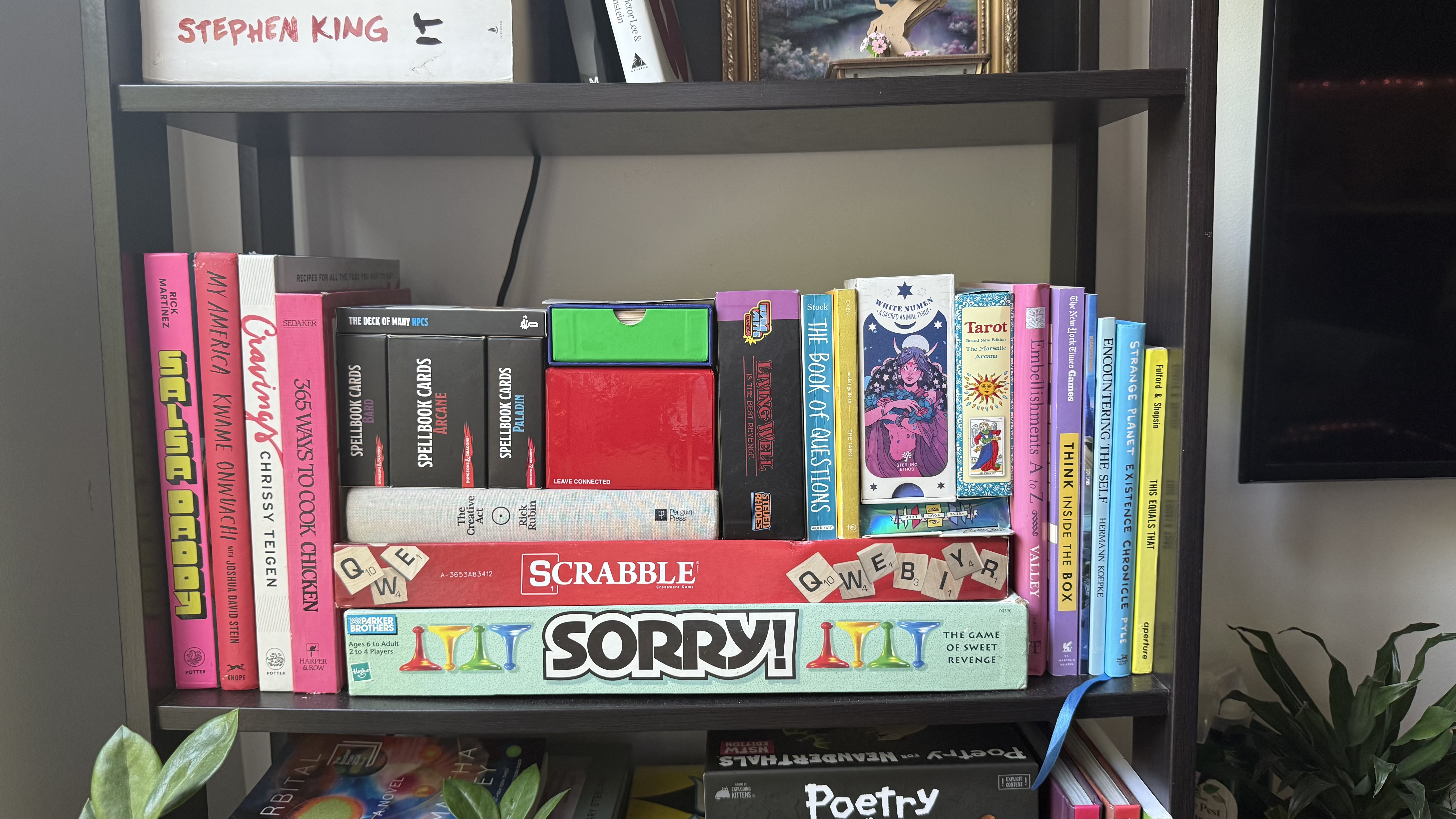
And straight from D’LOURDES’ Tetris brain, proof that the obsession lives off the screen too. She offered to send pictures of her bookshelf. We took her up on it.


Section 02
Credits
- Guest
- D’LOURDES
- Hosts
- Eva McCloskey & Pamala Buzick Kim
- Creative Director
+ Show Producer - Ky Meyer · Kollective Media
- Producer + Editor
- Narciso Palma · Kollective Media
- Creative Partner
- Tom Christmann · TiNY Ad Agency
- Music Producer
- Elijah B Torn
- Production
- A mavenverse production
Section 03
Transcript
Draft transcript, auto-transcribed, lightly cleaned, and not yet split by speaker. Names and terms may be misspelled.
Read full transcript (~22 min)
0:00 I'm scared. I'm scared of myself when I start talking about Tetris because I don't know who I am when I start talking about Tetris, The internet wants you to know a little about everything. Headline here, a trending topic there. Just enough to have an opinion. but never enough to understand. This is, you know, too much. a show about the opposite.
0:19 The people who go all the way down the rabbit hole, the collector, the overthinker, the obsessive. This is, you know, too much. I'm Dolores, and I know too much about one simple game that has stayed iconic for decades because I. I'm obsessed with it. To. And today we're talking all things Tetris from falling blocks and split second decisions to the strange magic behind one of the most iconic games ever created,
0:47 I'm Iva McCluskey, and I'm Pamela Busa Kim. we're joined by someone who truly knows way too much about it. Today's guest is Dolores, and trust us, by the end of this episode, we're going to have all of us knowing way too much to hate. Dolores. Yeah. Hey, hey. What's up? Oh, my gosh, this is, like, the nerdiest thing I think I'll ever do
1:08 All right, thank you. All right. You made it sound so very cool. And yet it was just like me fixated at, like, really strange hours of the night on given days with it. Yeah. I mean, that's what we want to know all about. What? What started this? Why? Like, take us there, diva? I don't know, I think. Okay, so I live near a barcade. Okay. Take you back to East Williamsburg and I live here.
1:37 Barcade and I, there's a Tetris machine there. And I just remember showing up with friends once and being like, this is all I want to do. You guys go somewhere else. And then it got me to redownload like the Tetris game on my phone. And this happens every time I play Tetris. I'll start to play it, and it's the only thing I do.
1:53 And then people around me will watch me play it and go, wow, you're like, really good at it and like a concerned way. And I'm like, oh. And it got to a point where I was playing it at the park and I was, doing really well. And I, got to score that one on the leaderboard of like top eight at this Barcade and I turned around and there was like a crowd of four. They were like, wow. I was like, oh my God. Oh no. It's happening. I'm that one at the arcade, I love it. How far does like one play go? Like, how long you like?
2:22 How many minutes are you playing? I'm like one $0.50. it depends on the console you're on. So like on like an arcade version, you can, you know, go as long as you can manage and it'll give you different levels and all that other stuff. But because there's other versions like on the Nintendo home consoles, like those can go for so long that you can start to like they have kill codes, and then you have to like beat the kill codes to then go to the highest point, like it becomes a game of
2:52 Math and algorithms to, like, beat the algorithm to get past the kill code, to then get the highest scores in the world. That's not where I've gone yet, and I really hope I don't get there because they there's certain techniques that you can play that will get you like playing into the record explorers of these Tetris games I, I yeah, it's crazy I had it.
3:13 Yeah. How did you like this? Did. I don't ever associate myself with math as a concept, ever. So, I mean, knowing about this is kind of super odd, and it's kind of the closest I get to talking about coding and algorithms that are not on like social media algorithms, but like it got to that because one of my day jobs is painting, which is a very menial tasks.
3:35 So sometimes, you know, you put on podcasts and stuff like that. And I stumbled upon a video about Tetris and I was like, yes, yes, let me get yeah, let me get into that. And then suddenly it was all I could think about. And part of the interest of those of those videos was one about the history of Tetris, which is the thing that I found particularly obsession with
3:57 They made a movie out of it. It's called Patriots, I think. What? Yeah. Isn't it? Yes. Isn't it called Tetris? It's like We're going to have to call in and see what kind of fact checking we can get done on the movie details. I have oh, my God. I'm like. I'm, like, sweating. This is the most vulnerable thing I've ever done.
4:16 I'm like, half naked on stages and we talking about math and algorithms, making it sweat. it's obviously dramatic, but It's an international licensing battle between corporations that are trying to get the licensing for Tetris from someone who is in the Soviet Union, the Soviet Union, which is does not function in capitalism.
4:34 meaning one of them is communist and the other one is capitalism. So that's a whole saga in and of itself. It feels like a reality TV show, the way that that timeline went down. If you want to hear about the timeline, like, just give. I know this frigate. This is the point of the podcast and I like I understand that, and yet I'm scared. I'm scared of myself when I start talking about Tetris because I don't know who I am when I start talking about Tetris,
5:01 Okay. It was invented by a guy named Aleksey Pajitnov who's grew up in the Soviet Union. his mother was a journalist that, reported on movies, and his dad was a philosopher and a writer who is also a dissident of the Soviet Union. So that already says a lot about a mind to functions outside of the circumstance, right? Yeah. He's a kid, grows up to be a computer engineer.
5:24 He works in, you know, a government conglomerate because that's how Soviet Union kind of works. If I ever use the wrong words, you'll know what I mean. But he's working for the government, invents Tetris at this government agency. He can't sell it because it's not allowed. There. Eventually he gets burned a bunch of copies.
5:42 Everyone's obsessed with it at this place. The whole building. Twitter, it's on a computer, and they can burn copies to put on other computers. So it's functioning on computer systems. Amazing. So they're able to share it via physical copies. It somehow gets to Hungary because people were like, on a floppy disk. Yes, I think that means floppy disk.
6:04 My dad is actually a computer engineer, so I did have a large, clunky home computer with floppy disks at one point in my life. Robert Stein, who is, an owner of Andromeda Software. He goes to Hungary, sees this game getting played in the corner of their, like, tech building. And it's like, what is that? Can I get the licensing to that? And they were like, actually, it
6:25 comes to the Soviet Union. We can't deal is that you got to go behind the Iron Curtain. So he goes or he sends a telex which is a fax. Yes, a fax. Yes, I know what that is. Two guys I got you. So he sends a fax over to the creator, and the creator is like, oh yeah, I kind of want to sell it, but there's a language barrier. So he kind of says something like, we're interested. And Stein takes that as like, yes, I get to licensing. Yeah. Because printing money, right. He could have been this could have been manipulative.
6:58 It could have been dumb. Either option is not that great in Lost in Translation. Could be, of course, as businessmen are known to be innocent these days. Yes. he goes to Microsoft in the UK, which is a software division of, you guessed it, Maxwell Communications Corporation. Robert Maxwell, who also owns Spectrum Holiday in the US. So he he's a part of like two different tech subsidiaries, if that's the right word
7:28 in different countries. Stein still doesn't have this actual deal. And then he's trying to get the deal. And then the, Soviet Union steps in is like, stop. What are you doing? What do you mean? And he was like, oh, I'm just, you know, he's trying to work it out. He eventually finds a way for them to say, okay, you get it for PC only. And he was like, that's fine for now.
7:51 And he keeps moving. He keeps moving like everything is okay. There's no sign. Contracts. These are all considered verbal agreements with the Soviet. You have. Yes, I mean yes. You send a fax, you know, very, that's what I'm saying. I'm like, what do you mean? How is this happening? So He signs a deal. Meanwhile, everything's going on the market.
8:14 Ignore me. Tetris is going out in all of these countries regardless. And yet the deal is still in limbo. Eventually, he makes a deal with what becomes another entity in the Soviet Union. It's called, They eventually make the deal to stay on the on the contract. It's different types of computers. Remember that because that is a difficult phrasing, especially in the late 80s where there are varying. Yes, varying definitions of different types of computers. What is a computer? Because it's a shifting definition, which is a part of why I think this story is like incredibly intriguing, because we don't even have the proper definitions for these things that we're making contracts about.
9:02 Yeah. So he calls his colleagues. Robert Stein is like, yeah, we're good. They're like, you have arcade and handheld rights. And he's like, yep, totally. They're on the way. Sure, sure. Yeah. They're. Yeah. In the telex machine. Yeah. Yeah, totally. And we'll be right back after this. Hydration has been overdesigned. That's why use birch water is a return to simplicity.
9:41 100% organic birch sap. Nature's version of reverse osmosis. Learn about ooze at drink ooze. And now back to the show. Meanwhile in the US spectrum, Halabi has like a convention or like electronic show that a guy named Hank Rogers who is associated with Bulletproof Software, which is a Japanese gaming company. He sees Tetris and he's like, I would like to license that, do me that.
10:08 And then he tries to do a deal. And meanwhile they were like, you can't. It's already sold to Atari, which is another company to this ownership battle. He goes to Atari, the president of Atari. He essentially stocks the president of Atari in the parking lot and is like, can you give me a deal? The president's like, sorry, dude, already gave the arcade rights away to Sega, which is all of the arcade games you'll see if you see them now.
10:36 They're all Sega machines. But he was like, I'm willing to sell console rights. And then it eventually works out that he gets Nintendo in on the deal they start to do. Home, home home console rights. Meanwhile, remember, all of this hinges on the deal with Stein. That is kind of real. Kind of not. So everything's still going for the next like two years with this deal, like not being physical or like valid.
11:04 And so, Hank, because of the home console success of Nintendo and Tetris, he's like, I want the handheld rights. He calls Stein and Stein's like, what's going on? He starts to realize that no one has the handheld rights. This is new technology like the Gameboy. Yeah. Like you said. Yeah. So he's trying to get it in on the Gameboy and yet he's like, wait, does no one have these rights? And so Stein was like stressed because
11:35 the tech overlords in Soviet Union also came back to Stein and was like, we're not getting paid. We still aren't getting paid. Somehow, somehow in the middle of all of this, the Soviet Union still is not getting paid. And they're like three months late to their like, royalties. So Stein stressed as fuck and he's like, oh no. So he flies to Russia to figure it out. Hank in the same month is like, no one has these rights.
12:04 I think I have to go to Russia. And Kevin Maxwell of Microsoft, which is the UK company, also catches wind of Nintendo wanting to have a handheld rights and is also like, I'm going to go to Russia in the same month. So all these three men go to Russia to go get these rights. Hank somehow gets there first, so the Nintendo guy gets there first and they're like, who are you? Why the fuck are you here? Obviously, it's a strange setting and time to show up unannounced to a government organization in the Soviet Union. And he starts to explain it. And the leader of this league, his name is Belikov. Belikov is like no one has the rights to anything.
12:49 And Hank's like, oh no. So he, in good faith, explains the things that were signed to Lord. Like, this is what's happening. Because remember, they're in communism and everyone else is functioning in capitalism. And so is this making sense? Yes, I follow, but how does it resolve? How how do we get to us finding Tetris in Barcade
13:16 there's something in me that sees so much beauty it's such a simple game created by someone with whom had a lot of restrictions around him, in and found like inspiration in the puzzle games you played as a kid, had a passion for video games, and so many huge big are fighting over this extremely simple universal game, which is put the blocks in their place and have them disappear.
13:45 And the part in my brain that really likes it is the fact that when you solve the problem, they disappear. And I find that super sick and coming within this little brain palace of mine. And I think it's just really cool, the fact that it's so dramatic and like, ridiculous just to get this game that really is advertised for everybody because it is for everybody.
14:04 Is this making sense? It's making a lot of sense and question follow up. Yes. Yeah. Have you heard the the I don't know if it's a rumor or you know, it's like a headline. I have not clicked into properly, but is it true that it does do beautiful things to your brain chemistry? If you play Tetris immediately following a severe trauma?
14:29 Yes, that is correct. Making that up right? No, no, you're not making that up. I can't say I know the specifics about why that is. I think it has something to do with allowing your brain to like organizing, compartmentalize in a sense, there's something spatially related and, and something that has to do with organization and compartmentalization that all goes with these things.
14:51 And if you go look at, like my bookshelf in my living room, it is Tetris. I like, have books turned like, you know, books and games turned just because there's so much order like random shapes to me. And so I think like, that's a huge part of the beauty that I see in Tetris Yeah. I mean, yeah, I love how you put that all in perspective. I do have to drive us back to so the three dudes go to Russia. Yeah. What happened? Did they all get the rights? It's. So
15:22 you were like, wait. I'm like, wait, what about the three dudes in the. Please don't leave me hanging about the three dudes in Russia. So the three dudes in Russia, Hank Rogers in Good Faith explains to the Soviet Union, like, this is the deal you guys got yourselves in. It's Loki, a piece of shit deal. And it's a vague wording. Different types of computers. That's what got you guys in the shitter.
15:47 And so these dudes, their lawyers, right, I guess. No, but Hank Rogers, Hank, the Nintendo guy, he seems to know the best about what's going on because he's also an honest man. My man, Hank Rogers. Yep. And so he. Yeah, he tells them the truth. Essentially, turns it around on Stein specifically. They give him back the old contract with an amendment.
16:11 He doesn't notice because he's distracted by late penalties. But the amendment defines computers. So it defined it as, Consists of a process monitor, disk drive, keyboard and operating system. And since the document was backdated, it stripped away all console rights. Stein thought he would actually, Oh. So they. Oh, sorry. All slipped. Commie.
16:35 Cop capitalism on the head, you know what I mean? They did a back. Yes. So they did him back. I know, I don't know what deal they give Maxwell. I think Maxwell just got, like he wanted to buy handheld rights. And Lord told Hank Rogers, and Hank was like, dude, I'm not going to be able to outbid Maxwell, but I can give you honesty and I will promise to pay you.
16:59 And so they, you know, they they went with Hank. And also in all of this, the thing that really drives my heart to this story, finally we're here is Alexi Pajitnov, the guy who invented Tetris has not seen a penny of this at all. Not yet. He's in the room. Yeah, well, the thing is, it's not legal for him to benefit, right?
17:23 Oh, yeah. But so he hasn't. He hasn't seen a penny of it at all. Eventually in the middle of all these meetings before, you know, before everyone decides everything, they eventually go with Rogers and then Nintendo. Deal. The rest is history. But Hank and Alexi in the middle of these meetings end up going out to drinks together, getting along.
17:42 They talk video games together. They strike a really meaningful, genuine friendship. And so, you know, the rest is history. Nintendo takes it. All other companies cease production. Everyone else is mad, blah blah blah blah. And like, after all that happens, Hank finally has money. And like four years later to help Alexi Pajitnov relocate to Seattle with his family.
18:07 And then I think four years later in like 95 fact check me on that. 95 he and Alexi Pajitnov, the original creator, and Hank Rogers are co-owners of the Dutch company, and he got all the royalties that he didn't get to get in. And, oh, we can exhale, thank goodness. I know he hanging on the edge of our seats there, but like that is that is beautiful.
18:34 There is so much beauty and touches. I love that that resolved for them. I know, and I think it's like one of the few stories and like business and legalities and bullshit that like the little guy came out on top and like how it ended, how it should have with people in good faith, and the guy who invented it who like, you know, created something out of nothing.
18:56 And I think that's really beautiful. So every time I'm playing and I'm like, for you, Alexi Pajitnov, I love it. Yeah, I think it's awesome. Yeah. When you first discovered Tetris, how long was it until you went to go read up the history, etc.? It's probably like a week. I think it was. I think I was just playing it a lot.
19:20 And so I just had to read up on it because I was like, are you joking? This like tiny game that takes up so much time in my life, actually. Like, I'm actually just like everyone else in the world fighting to like, play this very simple game. And it's like, no wonder. Yeah, that's that's. Yeah. But I also just love how you sort of like compared it to like, real life, how we're all sort of drawing within the lines.
19:46 But you can everyone can draw differently, and the satisfaction of having a row disappear when you've completed it. Yeah. And also all of those things are really I don't think I've ever really thought about process Tetris like that ever before. And I play a lot of it. But yeah, I think that's really gorgeous and beautiful. Yeah. Like, I want to be able to to put real life problems into the Tetris.
20:12 And, and I have said that before, I would love it if I solve them and they just disappear. That'd be super sick. And then they give me more points and I can get a high score. I can get all of it. All of it. It would be super sick. My God. Yeah, I appreciate you see so much beauty. And what is kind of one of the weirdest left turns in my personality I could imagine, because this just doesn't align with anything else I'm interested in. And oh, do you,
20:39 play Tetris before you go on stage? I don't, I don't, I honestly, I think I don't play Tetris as much as I advertise right now in this conversation, but every time I do it is for like two hours looking down on my phone and like, I have gone to arcades in the day and been the person with the backpack. Yeah. Stood there. So I haven't played them before a show. That's why I'm like, I really can't express to you why or how I got here in terms of this fixation. It is genuine and random. Yeah. Love it. So I feel very full. I feel very full from this conversation.
21:18 Yeah. In a good way. Good. Yeah. Thank you so much for telling us. You're like what you know too much about and sharing with us. And even if it is a left field, I, it probably integrates it far more into your everyday life than you probably realize in your brain space. I know, I wish I could articulate it and zoom out and explain to you why it like helps me,
21:39 create and be a person. But sometimes the things you're fixated on don't really have an explanation. Besides, you know, just another detail about your character and who you are. So thanks for making me feel comfortable to get a little bit crazy that we love it. That's what we're here for, you know, if you enjoyed this conversation, please subscribe, leave us a review, and share this episode with someone who will love it.
22:04 Explore more episodes and behind the scenes content at You Know Too Much Media. Follow us on Instagram and YouTube to keep the obsession going. Thank you so much! The thank you. Thanks for having me. This was amazing.